Коротко
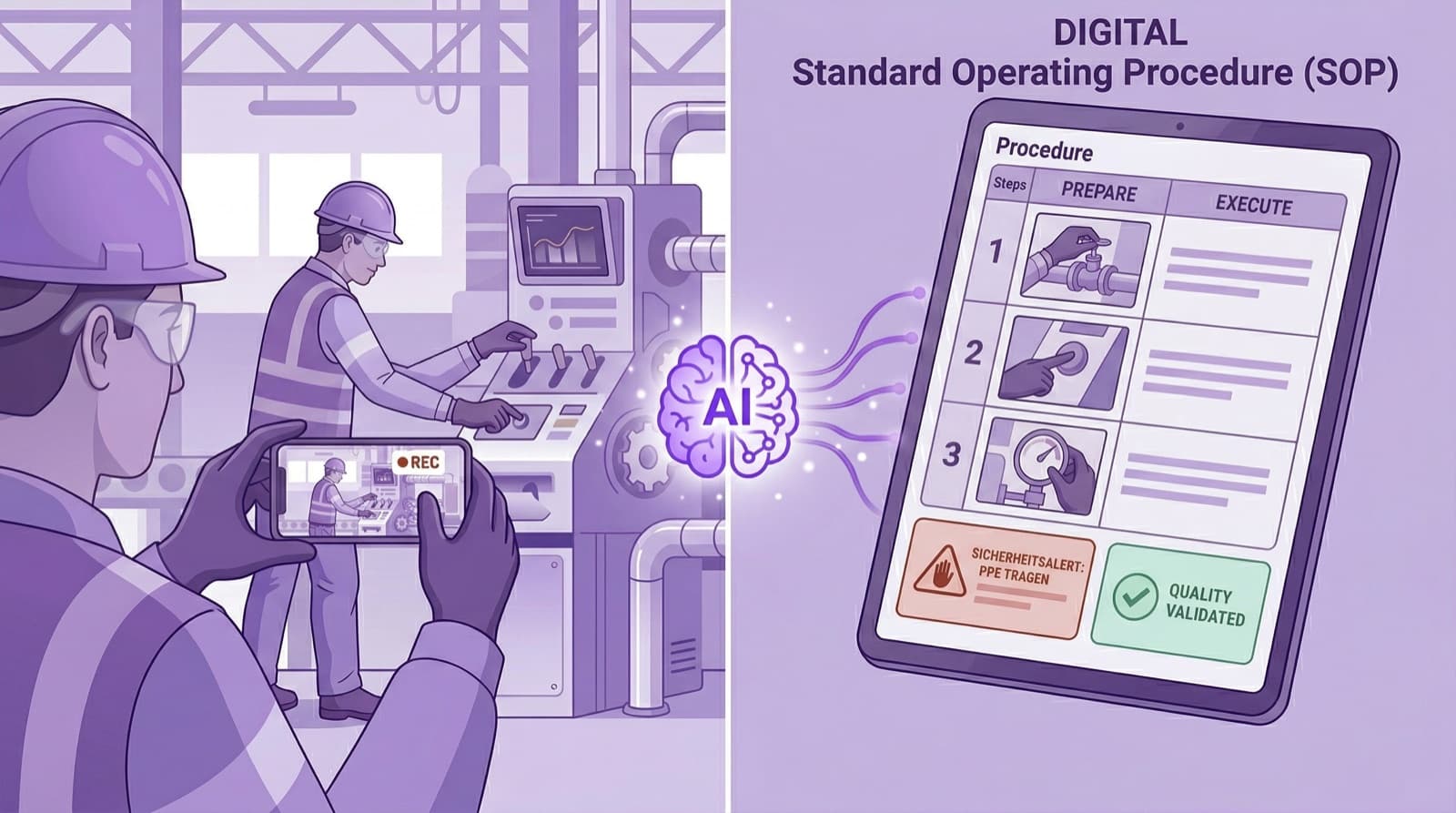
- 1.In the drafts we reviewed, detail went missing at specific, recognizable moments in the recording, not evenly across the video.
- 2.The clearest pattern: long stretches of silent work. In one 11-minute recording, four silent stretches of 27 to 53 seconds fell exactly on the work inside the machine, and the draft covered that part with a single step.
- 3.Recordings in the technician's first language came back with clean transcripts. Recordings in a second language lost technical terms.
- 4.Conversations on camera were the weakest input: questions and guesses ended up in the draft.
- 5.One gap was ours: a setting that was said out loud as a number was missing from the draft. That is a defect, and we treat it as one.
Lessons from a bilingual pilot with the field-service team of an international recycling group in Canada. We compared every draft with its recording, line by line. Most of the missing detail traces back to a handful of recording moments — and one gap was on our side.
Near the end of the pilot, the team's methods lead asked us a question we had not expected: “Is there anything Soperion cannot do?” There is. It cannot smell. And it cannot describe what is neither shown nor said in a recording. This article is about where that second limit shows up in practice.
How we looked at it
This is one pilot, not a study. The team — around twenty field technicians who maintain equipment at customer sites — recorded procedures with their phones in July and August 2026, in French and English. Some recorders had been through our recording training; some joined the team after a reorganization and had not.
The team received the pilot very positively, and it made their work noticeably easier. That is exactly why we looked closely at the places where the drafts fell short.
For this article we took the six physical procedures recorded in the final phase of the pilot. We left out two office procedures (screen-based, a different route) and the earliest uploads, which had almost no narration and would not tell us anything about the platform. For each of the six, we read the transcript and the draft side by side, watched the video at every point where the two disagreed, and wrote down what was missing, what was wrong and what caused it.
The procedures differ in kind — a cleaning routine is not a motor test — so we do not compare step counts between them or draw a statistical line through six points. What we can say is where, inside each recording, the draft lost detail.
| Procedure | Language | Length | Speech share | Where the draft lost detail |
|---|---|---|---|---|
| Cleaning routine | EN | 6:01 | 83 % | Little; some screen steps unreadable in the picture |
| Fill-level monitoring | EN | 3:33 | 88 % | Explanations became steps (Q&A format) |
| Belt replacement | EN | 11:29 | 52 % | Four silent stretches inside the machine; part name misheard |
| Motor rotation test | FR | 7:05 | 55 % | One spoken value dropped; one correction resolved the wrong way |
| Sensor calibration | FR | 5:58 | 59 % | First take recorded twice; draft correctly used the second |
| Jam clearing | EN | 0:52 | 82 % | Precondition (“close the door”) missing |
Silent work leaves no trace in the draft
The belt replacement is the clearest case. The procedure has an easy part — opening the unit, removing covers — and a hard part, inside the machine, where the old guide comes out and the new one goes in. The technician narrated the easy part. During the hard part, he concentrated, and there are four silent stretches of 27 to 53 seconds.
The draft mirrors that exactly. The opening and the covers come out as separate, well-described steps. The work inside the machine, two and a half minutes of it, is one step.
The reason is not mysterious. A video-to-SOP system works from two sources at once: the picture and the speech. The picture shows that hands move inside the machine. It rarely shows which part is released first, in which direction, or why. Without speech, the system can tell that something is happening, but not where one meaningful action ends and the next begins, so it merges them.
The team described this in their own words at the end of the pilot: long jobs “felt thin” compared with short ones. In our reading, the thinness is in the silent parts, not in the length.
What to do: say what you do while you do it. When the work needs full concentration, pause the recording, do the step, then repeat it on camera with narration — or describe it right after, while the hands are still on the part.
The value that was said and then lost
This one was ours. In the motor rotation test, the technician connects a tester and sets it before starting. The recording, translated from French:
“Plug in one or the other, make sure the tester is set to 45. The adjustment is very sensitive. Off we go.”
The draft:
Adjust the sensitivity and start the test. Turn the potentiometer to adjust the sensitivity.
What the step should say:
Set the tester to 45 and start the test. The adjustment is very sensitive. Check the setting before starting.
The draft is not wrong. It is useless, because the number was the step. The team told us this was the moment their trust in the drafts dropped: once a reviewer finds one dropped value, they start re-watching every video next to every draft, and the time saving is gone.
A spoken value should never depend on a reviewer's attention. Every number said in the recording should either appear in the draft or be flagged as missing, and that check belongs in the software, not in the review.
When the speaker corrects himself
In the same recording, the technician first says the second motor is turning the right way. A few minutes later, with a colleague, he concludes that it is not, and explains why. The draft built its quality check on the first statement.
Real people correct themselves while they work. That is normal and useful. A draft should show both statements, with their timestamps, and leave the decision to the reviewer. We cover this failure mode and four others in five AI errors that reviewers miss on a quick read.
Record in the language you think in
The two French recordings came back with transcripts that needed almost no correction. Several English recordings, made by French-speaking technicians, did not: one part name was transcribed four different ways, none of them right, and the error carried into the step text and the tool list.
Speech recognition is very good at fluent speech in any major language and noticeably worse at technical vocabulary in an accent it did not expect. For a bilingual team the conclusion is slightly counterintuitive: record in your first language and let the platform produce the second. A clean French draft translated into English is better English than a transcript of hesitant English. More on this in multilingual work instructions.
Conversations are not instructions
Two recordings were conversations: one person working, another asking. “How often do you have to clean this?” “Each day.” In a training session, that is a good way to learn. For a system that turns speech into steps, it is ambiguous input. A question can become a step, and an answer to a hypothetical (“if it were turning the other way, you would swap the wires”) can read like an instruction for something that never happened.
If two people are on camera, agree before recording who explains and who films. Questions go in the pause.
What worked
The French calibration procedure came out close to release-ready. The camera was close to the screen, the narration was continuous, and the reference value the technician gave for a good result ended up in the quality check. The system also skipped a false start correctly: the first take had been recorded twice, and the draft began with the second.
The cleaning routine captured practical knowledge you will not find in a manual: that a cleaning cycle normally takes five to ten minutes and a much shorter one in the history is a warning sign. That kind of knowledge is why teams record procedures in the first place.
What changed on our side
1. Spoken values are evidence. A value said in the recording and missing from the draft is a defect, not a style choice.
2. Every pilot now has a joint review after the first three to five SOPs, with the people who recorded them, draft next to video. Every pattern in this article was visible in the first few drafts. We describe the full pilot design in why SOP software pilots end without a decision.
3. New team members get the recording training live. A session from two months ago does not survive a change in the team.
4. Confidential content can now be blacked out. Feedback from the pilot team led to a new redaction function in Soperion: anything in the picture that should not end up in the SOP can be blacked out.
Часто задаваемые вопросы
- Does a longer video produce a more detailed SOP?
- Not by itself. In this pilot, detail followed narration: the parts of a recording where the technician explained what he was doing became separate, detailed steps, and long silent stretches became one broad step.
- Should a bilingual team record in English to get English SOPs?
- No. Record in the language the technician thinks in and let the platform produce the other language. First-language transcripts were clean; second-language recordings lost technical terms.
- Can two people explain a procedure together on camera?
- Yes, if one explains and the other films. Questions and discussion belong in a pause of the recording, because a question asked on camera can end up as a step.
- What is the most important thing to say out loud while recording?
- Values: settings, torques, distances, limits. They are the details a picture cannot carry and the first thing a reviewer will check.