Listen to article:
At a glance
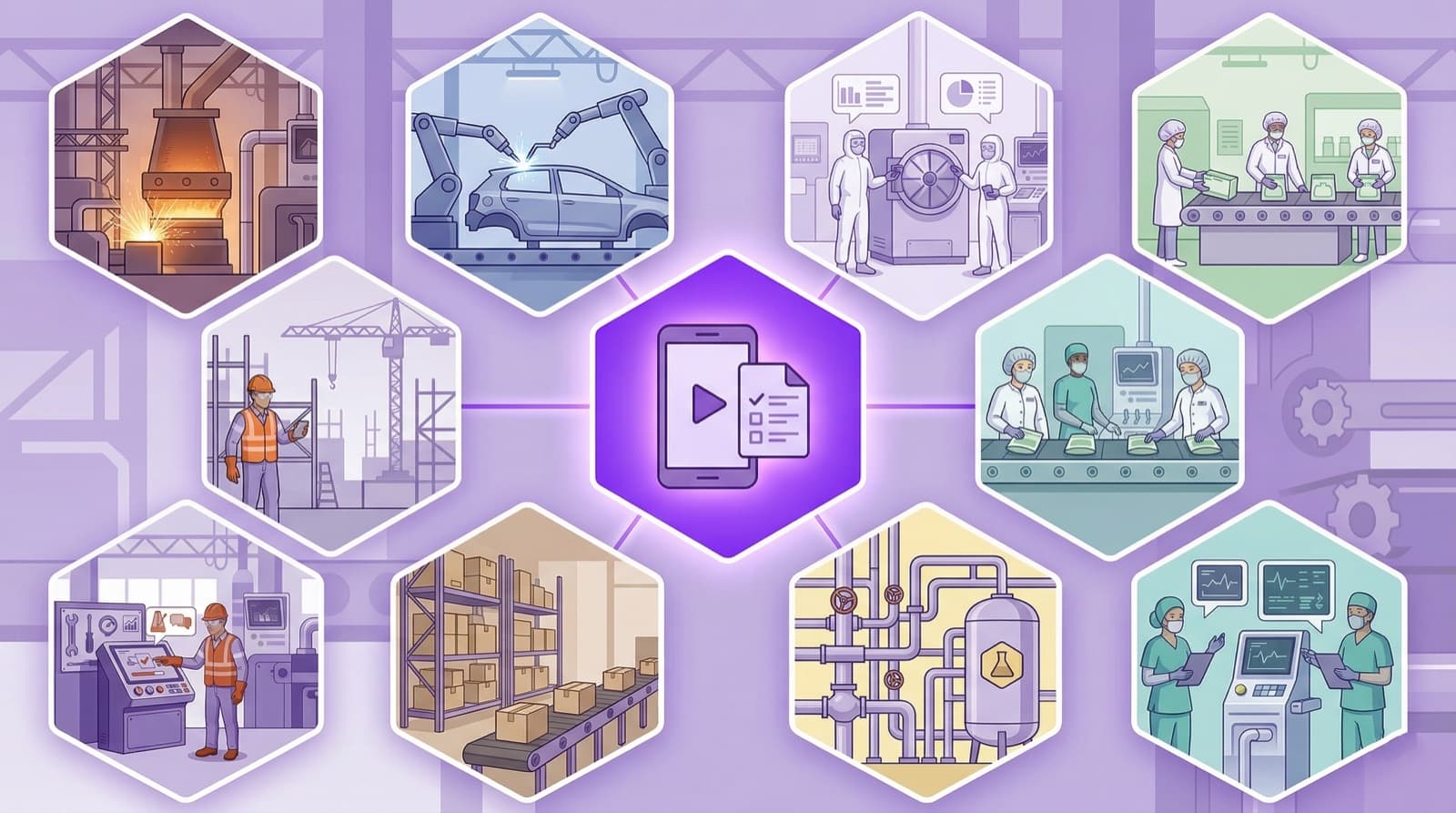
- 1.The decisive scaling question is not tool quality but the creation model: a central documentation team becomes the bottleneck at 1,000+ instructions per plant — key users scale with every plant.
- 2.Nine technical criteria decide the multi-site rollout: SSO (Entra ID), SAP/DMS integration, document control, multilingualism, roles and permissions, audit trail, global deployment, offline capability, and data residency.
- 3.Connected-worker platforms like Augmentir, Tulip, or Poka solve a different problem than SOP generation — mixing the two categories means comparing months-long rollout projects against tools deployed in days.
- 4.Reproducibility beats feature lists: an onboarding model with a fixed training effort per plant can be planned across 13, 50, or 100 sites — one with an integration project per site cannot.
The question is not how well a video becomes an SOP. The question is what happens when 50 plants work with it at the same time — identity, integrations, document control, offline operation.
Whoever selects SOP software for a single site evaluates output quality. Whoever selects for an enterprise has to ask a different question: what happens when 20, 50, or 100 plants work with it simultaneously — with different languages, their own IT landscape, and a works council per site? This article sorts the scaling criteria into two groups: the one factor that decides between success and standstill, and the nine technical criteria every corporate IT department should check in the vendor assessment.
Scaling factor no. 1: who creates the content?
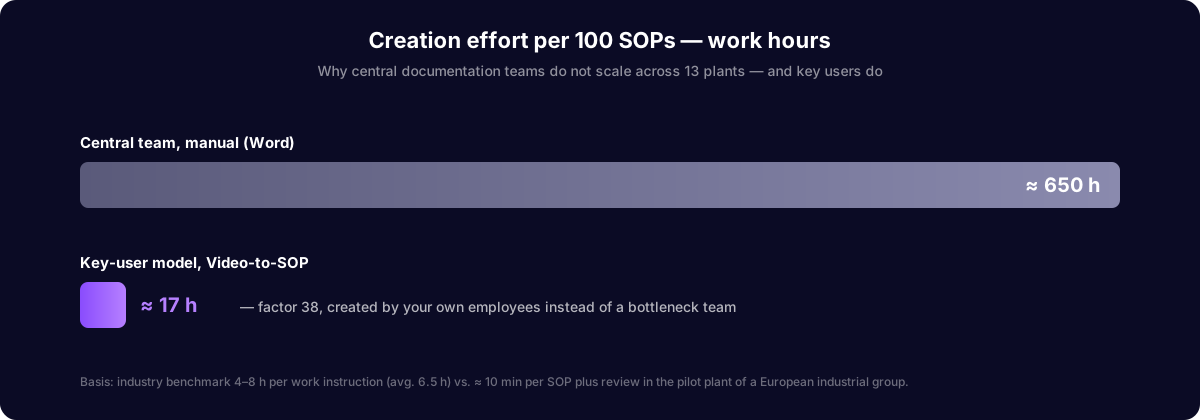
Every SOP platform scales technically — servers can be rented. What does not grow with you is the central documentation team. At an industry-typical 4 to 8 hours per work instruction and over 1,000 instructions per plant, a 10-plant rollout means several person-years of pure writing — per wave. That is why SOP programs shine in the pilot and stall in the rollout: the pilot documents 20 processes, the rollout needs 10,000.
The only model that scales is one where creation grows with every plant: key users on site capture the processes themselves, and the software handles structure, format, and document control. In the pilot plant of a European industrial group, 6 key users created 10 approval-ready SOPs in one hour after 2 days of training — from day 1 without external staff. This model can be planned across 13, 50, or 100 plants because the effort per plant stays constant: training, key users, done.
The 9 technical scaling criteria for the multi-site rollout
Once the creation model is settled, the technical foundation decides whether IT approves the rollout. These nine criteria appear in practically every enterprise assessment — and they separate tools for single teams from platforms for 100 plants.
| Criterion | What matters at enterprise scale |
|---|---|
| SSO / identity (Entra ID, SAML, OIDC) | No separate password silo; joiner-mover-leaver processes apply automatically, SCIM provisioning for 10,000+ users |
| SAP / DMS integration | Approved SOPs land automatically in the leading system (SAP, SharePoint, Teamcenter) — no duplicate maintenance |
| Document control | ID, version, approval workflow, archiving — compliant with ISO 9001 clause 7.5, without a parallel Excel |
| Multilingualism | One SOP, every plant language, same version and approval state — not 17 separate documents |
| Roles and permissions | Plant, area, line as permission levels; one plant does not see another plant's processes |
| Audit trail | Who changed, approved, read what and when — exportable for ISO, IATF, and GxP audits |
| Global deployment | Latency and availability outside Europe too; CDN delivery to the shop floor |
| Offline / edge capability | Halls with dead zones and locked-down Wi-Fi: SOPs must stay accessible at the workstation |
| Data residency & DPA | EU hosting, GDPR data processing agreement, works-council-ready anonymization |
Connected-worker platform or SOP generation: two categories, two rollouts
In enterprise assessments, Augmentir, Tulip, and Poka often land on the same shortlist as SOP generation tools. These are established, mature platforms — but a different category: connected-worker platforms digitalize frontline guidance as a whole, with machine connectivity, workflows, and analytics. The price is project complexity: a platform that connects machines and orchestrates processes gets configured per site — the rollout is an IT project with months of runtime per wave.
SOP generation applies the lever one level earlier: creating the standards themselves is automated, and delivery runs via QR codes without a device rollout. If the core problem is documentation and knowledge, this delivers in days per plant what a frontline platform needs months for. If you want to orchestrate machine data, worker guidance, and analytics in one system, a connected-worker platform is the right choice — and you should still evaluate SOP creation separately, because there too, the content has to be created first.
Govern centrally, create locally: the governance model
The scaling model that holds up in practice separates two responsibilities. The plants create — key users film and narrate their own processes, because only they hold the process knowledge. Headquarters governs — template standards, approval workflows, naming conventions, and the audit trail are uniform across the group. No shadow documentation emerges per site, and yet no plant waits for a central team.
The rollout becomes measurable through three KPIs: SOP coverage (documented vs. identified processes per plant), currency rate (share of SOPs younger than the defined revision interval), and time-to-standard (days from process change to approved new version). Whoever has these three numbers per plant on a dashboard sees early which site needs support — before the audit sees it.
Frequently asked questions
- How does SOP software scale to 50 or 100 plants?
- The creation model decides, not server capacity: key users per plant create the content themselves, while headquarters governs templates, approvals, and the audit trail. Technically, SSO (Entra ID), a per-plant role model, multilingualism, offline access, and SAP/DMS integration must be in place — otherwise every site becomes its own IT project.
- What separates SOP generation from connected-worker platforms like Tulip or Augmentir?
- Connected-worker platforms digitalize the entire frontline guidance including machine connectivity and analytics — the rollout is a configuration project per site. SOP generation automates creating the standards themselves and delivers them via QR code; onboarding takes days instead of months per plant. Which category fits depends on whether the core problem is documentation or process orchestration.
- Which KPIs show whether an SOP rollout is working?
- Three KPIs per plant: SOP coverage (documented vs. identified processes), currency rate (share of SOPs within the revision interval), and time-to-standard (days from process change to approved version). Together they show creation speed, maintenance discipline, and responsiveness.