Écouter l'article :
En un coup d'œil
- 1.Process videos are more sensitive than most office data: they show plant layouts, process parameters, and the know-how competitors care about. The data classification has to price that in.
- 2.The EU Cyber Resilience Act makes the SBOM (Software Bill of Materials) mandatory for products with digital elements — anyone buying SaaS today should already be able to request one.
- 3.NIS2 shifts responsibility into the supply chain: operators of essential entities must demonstrably assess their service providers' security — a vendor without verifiable answers becomes the customer's compliance risk.
- 4.An independent penetration test by an established testing firm is the hardest single piece of evidence available — harder than any self-issued compliance badge.
Process videos show plant layouts, parameters, and know-how. Uploading them to a cloud demands better answers than a compliance logo in the footer — SBOM, pentest practice, NIS2, and the eight questions of the vendor assessment.
When a plant uploads process videos to a SaaS platform, data leaves the building that was never meant for the outside: camera pans across equipment, visible parameters, the procedures a competitor would love to see. The question to the vendor is therefore not “are you secure?” — everyone answers yes. The question is: “what can you prove, and what happens when we verify it?” This article sorts what corporate IT should check in production-adjacent SaaS — and why NIS2 and the Cyber Resilience Act are fundamentally shifting the requirements right now.
Why process videos need a higher protection level than office data
The data classification for SOP software is often done as for any documentation tool — that underestimates the data class. A process video contains three layers of information worth protecting: the visible plant layout (relevant for sabotage and espionage scenarios), process parameters such as torques, temperatures, and inspection dimensions (the actual manufacturing know-how), and people (GDPR and co-determination).
Concrete requirements follow: encryption at rest and in transit is table stakes. What decides are tenant isolation (does plant A see plant B's processes?), key management, EU data residency with a solid data processing agreement, and the question of whether video data is used to train AI models — and if so, with what contractual guarantee the customer can rule that out.
NIS2 and the Cyber Resilience Act: the supply chain becomes an audit obligation
Two EU legal acts are shifting the burden of proof. NIS2 obliges essential and important entities — including large parts of manufacturing — to actively manage the cybersecurity of their supply chain. In practice: IT must assess and document the security of every SaaS vendor. A vendor who answers assessment questions evasively is no longer just a poor contract partner, but a compliance risk inside the customer's own NIS2 documentation.
The Cyber Resilience Act adds the product side: products with digital elements will require a Software Bill of Materials — a machine-readable parts list of all components and dependencies. The background is the lesson of Log4Shell and the supply-chain attacks of recent years: without an SBOM, nobody knows in an emergency which systems even contain a vulnerable library. For procurement this means: a vendor who cannot deliver an SBOM on request today does not have its dependency management under control — regardless of when the transition periods formally apply.
The vendor assessment: 8 questions that demand verifiable answers
The following eight points separate vendors with lived security practice from vendors with compliance slides. The second column names the evidence IT should request — not the self-declaration.
| Checkpoint | Verifiable evidence |
|---|---|
| Identity & access | SSO via Entra ID / SAML / OIDC, SCIM provisioning, enforced MFA for admin access |
| Encryption | TLS 1.2+ in transit, AES-256 at rest, documented key management |
| Data residency | EU data centers, DPA per Art. 28 GDPR, documented subprocessor list |
| Tenant isolation | Architecture description of tenant isolation, ideally covered in the pentest scope |
| SBOM | Machine-readable SBOM (CycloneDX / SPDX) on request, maintained dependency process |
| Independent pentest | Report by an established testing firm, scope and re-test of findings reviewable (NDA is standard) |
| Audit logging | Complete, exportable audit trail of access, changes, approvals |
| Exit & portability | Documented data export in open formats, contractual deletion periods |
How to recognize a penetration test that was meant seriously
“We do regular pentests” is the most common and emptiest answer in vendor assessments. Three attributes make it solid: first, the tester — an established, independent testing firm with a reputation, not the hoster's bundled scan service. Second, the scope — web application, APIs, and infrastructure including tenant isolation, not just an automated vulnerability scan. Third, the handling of results — findings, remediation, and re-test must be traceable for customers; providing the report under NDA is the standard and credible route in B2B.
Soperion recently went through this itself: a multi-week penetration test by SySS GmbH, one of Germany's most established independent security testing firms, covering application, APIs, and infrastructure. We make the report available to customer IT departments under NDA during the assessment — in our view, the only form in which the statement “we were tested” carries any audit value at all.
The underestimated stakeholder: works council and GDPR
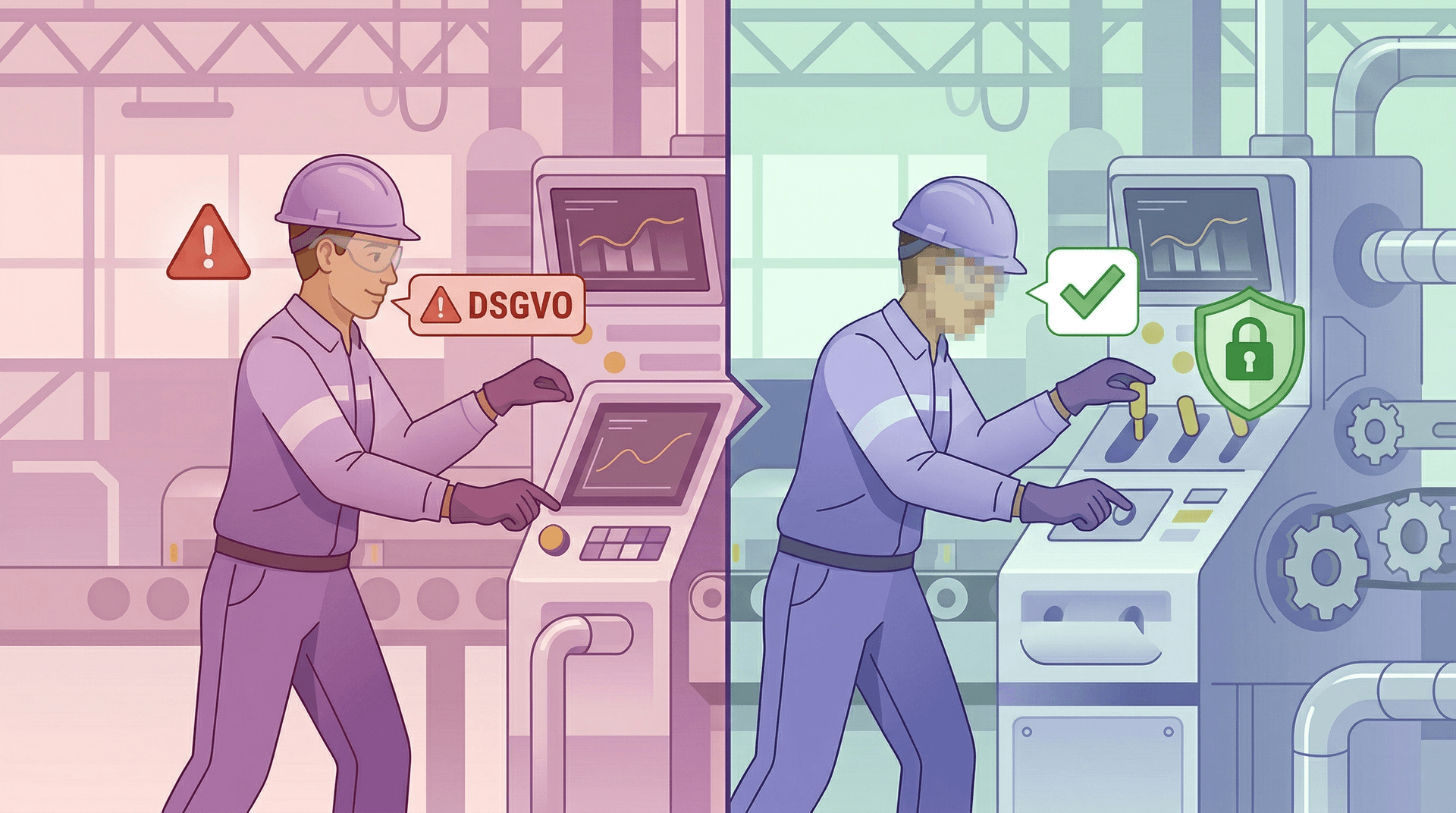
Production-adjacent SaaS rarely fails on technology and more often on co-determination. Where videos are recorded at the workplace, §87 of the German Works Constitution Act and the GDPR are triggered — making works council approval mandatory. Addressing this after tool selection costs months. The vendor-side answer is both technical and organizational: automatic face anonymization by default, no performance or behavior analysis of individuals, and prepared documentation for the works agreement that IT does not have to write itself.
Questions fréquentes
- What should IT demand from a SaaS vendor for manufacturing at minimum?
- Eight pieces of evidence: SSO with Entra ID/SAML incl. SCIM, encryption at rest and in transit, EU data residency with a DPA, documented tenant isolation, an SBOM on request, an independent pentest report (under NDA), exportable audit logging, and contractually agreed data portability. What counts in each case is verifiable evidence, not self-declaration.
- Why does an SBOM matter in software procurement?
- The Software Bill of Materials lists all components and dependencies of a product in machine-readable form. With a vulnerability like Log4Shell, it decides whether it takes hours or weeks to know which systems are affected. The EU Cyber Resilience Act makes it mandatory for products with digital elements — vendors who cannot deliver one today do not have their dependency management under control.
- Has Soperion undergone an independent penetration test?
- Yes — a multi-week penetration test by SySS GmbH, one of Germany's most established independent security testing firms, covering application, APIs, and infrastructure. The report is available to customer IT departments under NDA during the vendor assessment.