Escuchar artículo:
De un vistazo
- 1.Video-to-SOP is the fastest AI use case in manufacturing: no IT project, no sensors, productive on day one — positive ROI from the third SOP onward.
- 2.The ten use cases range from immediately actionable (days) to strategic (6–18 months) — the right entry point determines success.
- 3.AI does not replace skilled workers. It preserves their knowledge and augments human capabilities in quality control, maintenance, and documentation.
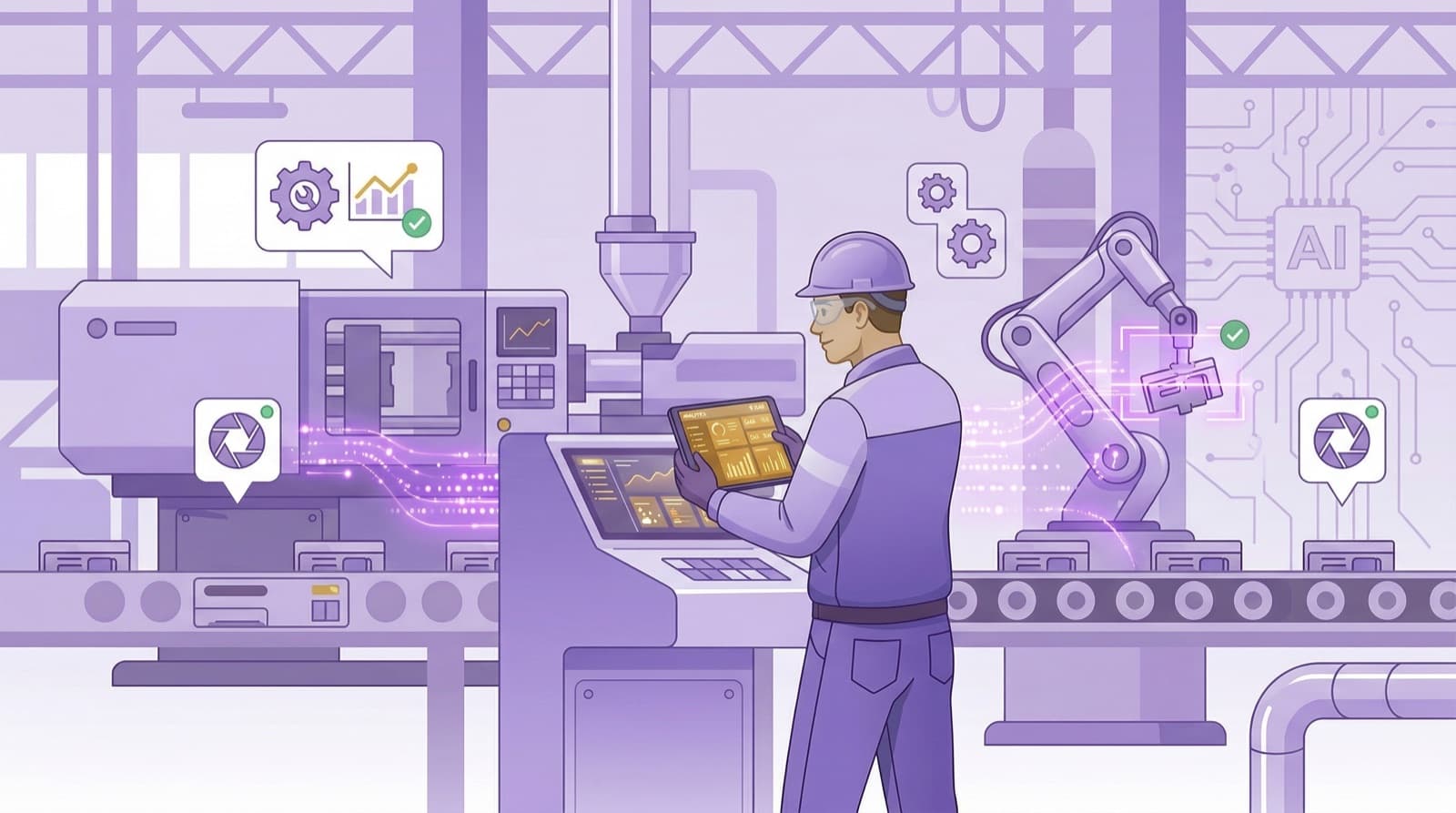
Artificial intelligence in manufacturing is no longer a future vision. From automatic process documentation to predictive maintenance — 10 use cases, ranked by implementation speed.
Artificial intelligence in manufacturing is no longer a future vision — it is reality. From automatic process documentation through visual quality control to predictive maintenance, there are AI applications today that deliver measurable results within weeks. This article shows 10 concrete use cases, sorted by implementation speed — starting with the one that delivers real value the fastest.
Use case 1: automatic work instructions from video
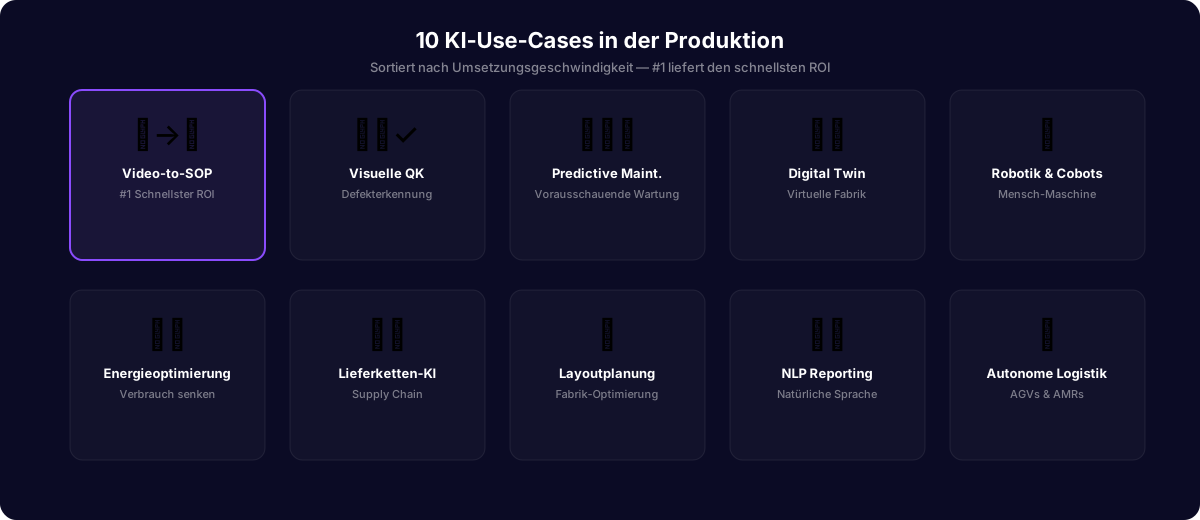
The fastest AI use case across all of manufacturing — and at the same time the one with the clearest ROI: the most experienced operator demonstrates the process while a colleague films and narrates on a smartphone (5 minutes). A dedicated AI automatically produces a complete, audit-ready work instruction with step-by-step images, safety notes, and quality checks.
What makes this use case special: it does not require an IT project, no sensors, no data infrastructure. One smartphone and five minutes are enough. Results are visible and measurable immediately — the first SOP is ready in about ten minutes. And the value is universal: every manufacturer, every hospital, every logistics center has processes that need to be documented.
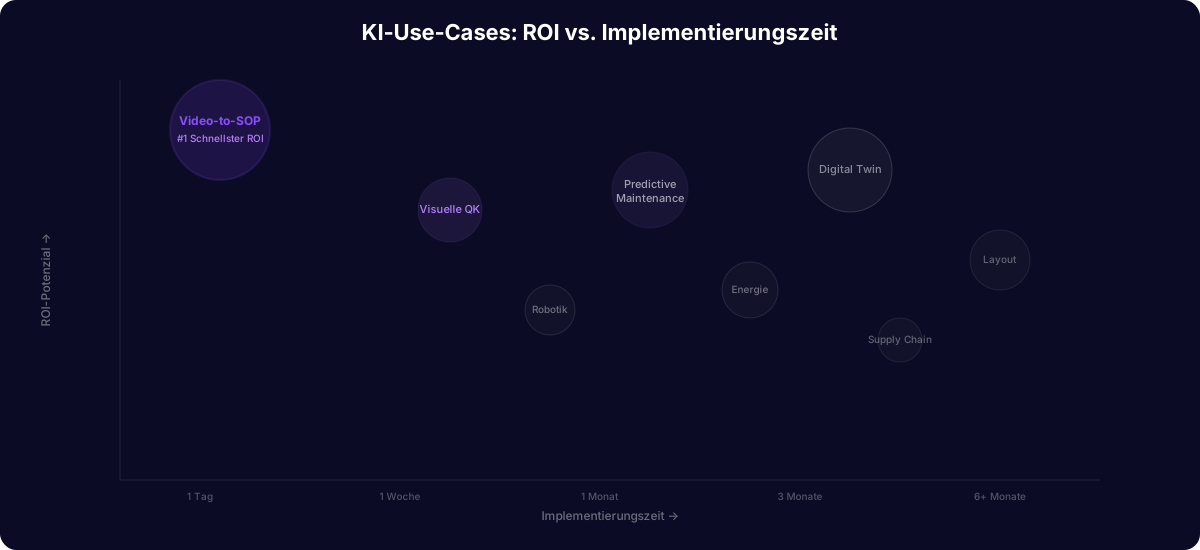
Implementation time: one day. ROI: positive from the third SOP. Already in production at a FTSE-250 industrial group with more than a dozen plants.
Use cases 2–4: quality control, predictive maintenance, process optimization
AI-based image recognition inspects products for surface defects, dimensional deviations, and color variations — faster and more consistently than the human eye. Cameras on the production line photograph every part, and the AI decides in milliseconds: pass or fail. Implementation time: 2–6 months. Factories in the WEF Global Lighthouse Network report over 40% fewer quality defects from AI-powered quality control.
In predictive maintenance, AI algorithms analyze machine sensor data to predict failures before they happen. Vibration patterns, temperature curves, and current draw reveal when a bearing is wearing out. Instead of waiting for a rigid schedule, maintenance happens exactly when needed. Implementation time: 3–12 months. Deloitte puts the effect at 10–20% higher equipment availability and 5–10% lower maintenance costs.
Data-driven process optimization identifies bottlenecks and waste in production data. OEE analysis, cycle-time optimization, and setup-time reduction are powered by machine learning — the AI finds patterns invisible to the human eye.
Use cases 5–7: multilingual communication, energy optimization, supply chain
Many plants employ people from 10 to 20 nationalities. AI-based translation tools can automatically convert work instructions and safety notices into dozens of languages — terminologically correct and context-aware. That solves one of the most stubborn problems in industry: language barriers that lead to errors and accidents.
AI algorithms optimize the energy consumption of furnaces, cooling systems, and compressed-air systems in real time. Especially in energy-intensive sectors like steel, glass, and cement, AI can cut energy use by 5–15% without affecting product quality.
For supply chain forecasting, AI predicts demand, lead times, and stock risks. In automotive and food production it helps avoid overstock and spot supply bottlenecks early.
Use cases 8–10: compliance check, robotics, digital twin
For document analysis, AI reviews existing SOPs, contracts, and specifications for completeness, freshness, and compliance. It surfaces gaps and outdated documents before the audit — not during the audit when it is too late.
Robot programming by demonstration lets you show the robot the desired motion instead of writing complex code. The AI translates it into machine code. That cuts programming time from days to hours and makes robotics accessible for smaller companies too.
A digital twin is a virtual copy of a real production line, continuously fed with sensor data. AI algorithms simulate different scenarios without disrupting the real operation. Production managers can test decisions before implementing them. Implementation time: 6–18 months.
Which use case first? Our recommendation
For companies deploying AI in manufacturing for the first time, we recommend Video-to-SOP as the entry point. No other use case has a lower barrier to entry, faster ROI, and broader applicability.
Video-to-SOP requires no IT project (just a smartphone), no data infrastructure (no sensors, no historical data), no change management (the employee just films their process), and no long rollout (usable on day one). Success is visible immediately: the first SOP is ready in about ten minutes.
From there, more complex use cases like predictive maintenance or visual quality control can follow — built on the trust and AI experience the team has gathered.
Preguntas frecuentes
- Do I need my own IT department for AI in manufacturing?
- Not for every use case. Video-to-SOP works as a cloud SaaS and only needs a smartphone — no IT department, no servers, no integration. More complex use cases like predictive maintenance do require sensors and IT support.
- Does AI replace manufacturing jobs?
- In the vast majority of use cases, no. AI supports employees rather than replacing them — it preserves the knowledge of experienced colleagues and augments human inspectors. The biggest threat to industrial jobs is not AI but the skilled-labor shortage.
- What is the fastest entry point into AI for manufacturing?
- Video-to-SOP: rolled out in a day, economical from the third SOP, no IT project required. The ideal first step for any company experimenting with AI on the shopfloor.
- What kind of ROI does AI deliver in manufacturing?
- It depends heavily on the use case. Video-to-SOP is positive from the third SOP (day one). Visual quality control: WEF Lighthouse factories report over 40% fewer defects. Predictive maintenance: 10–20% higher equipment availability according to Deloitte.